
Digital PR for AI Visibility: How a PR Article Ends Up in ChatGPT's Answer
Digital PR is worth it if you want ChatGPT to mention you, but only on two conditions. The article must be written so that AI can pull a clear fact about your brand out of it, and it must be on a news site that AI actually reads. In our research into Croatian AI answers (30 October 2026), a PR article appeared as a source in 1 of 45 answers. Most PR articles today do not end up in an answer, which also means competition for a mention is still low.
Below you will find the path a PR article takes to a ChatGPT answer, a template for an article written for AI citation, criteria for choosing a news site and an 8-point checklist.
Is digital PR worth it if you want ChatGPT to recommend you?
Yes, because AI assistants do not answer only from content on your website. Jake Ward writes on LinkedIn that AI builds answers from information across the whole web, and that Google highlights YouTube, Reddit, publications and other third-party sources in its results. The same author stresses that your website alone cannot cover the whole search market. An article on a news site is exactly that kind of third-party source: someone else, not you, states that your company exists, what it does and where.
The second reason comes from Google itself. In “Good SEO is good GEO”, Brendon Kraham of Google says that AI Mode and AI Overviews pull current information from Google’s existing index and rest on the same ranking and quality systems as classic search. The piece was shared and summarised by Alex Groberman on X. For you, this means GEO is not a separate discipline. An article that Google indexes and ranks well has a better chance of getting into an AI Overview too.
A realistic expectation: a well-written article on the right news site increases the chance of a mention. It does not guarantee one. Read more about how AI chooses sources in our guide to LLM visibility.
How an article on a Croatian news site reaches a ChatGPT answer
The article goes through six steps. If it gets stuck at any of them, there is no mention.
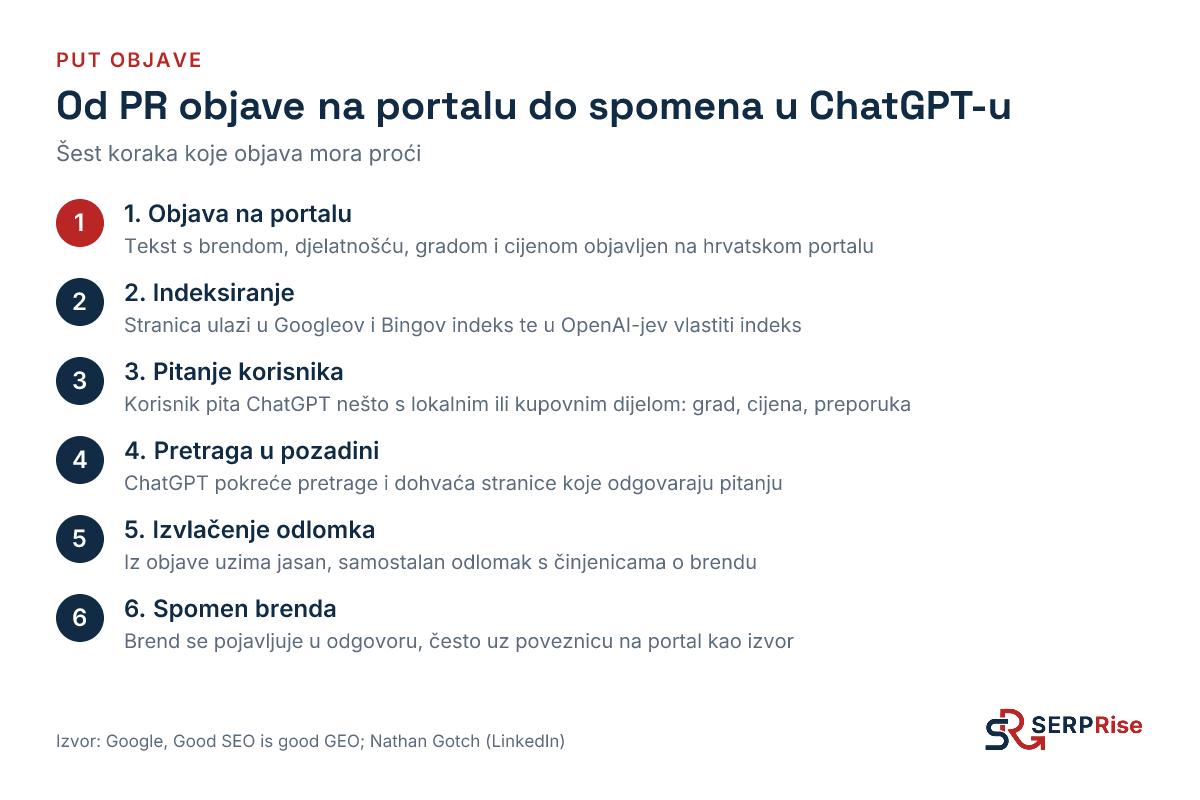
- Publication on the news site. A text with the brand, line of business, city and price.
- Indexing. The page gets into the indexes AI uses.
- The user’s question. Someone asks ChatGPT something with a local or buying element.
- Background search. ChatGPT runs searches and fetches pages.
- Extracting a passage. It takes a clear, self-contained paragraph from the article.
- Brand mention. The brand appears in the answer, often with a link to the news site.
Step 2 is a problem more often than people think. ChatGPT does not use only Google. Nathan Gotch on LinkedIn shows an example of a page ChatGPT cites even though it is not in Google’s index. The explanation: OpenAI has its own search index (Gotch calls it Labrador, citing research by the Peec team), and alongside it also uses Bing’s index. The page in his example was indexed in Bing. The practical conclusion: the news site you publish on must be indexed in Bing too.
Step 3 determines the content of the article. ChatGPT cites Croatian pages more often when a question has a local or buying element: Croatia, a city, a price, an agency. If your article has no city, line of business and price, it has nothing to answer with. You can see for yourself in the browser which searches ChatGPT runs for questions in your industry. We describe the method in the article how to see what ChatGPT searches for.
How does a PR article for AI differ from a classic press release?
A classic press release tells a story and builds an impression. An article for AI gives clear facts that still make sense when lifted out of the text.
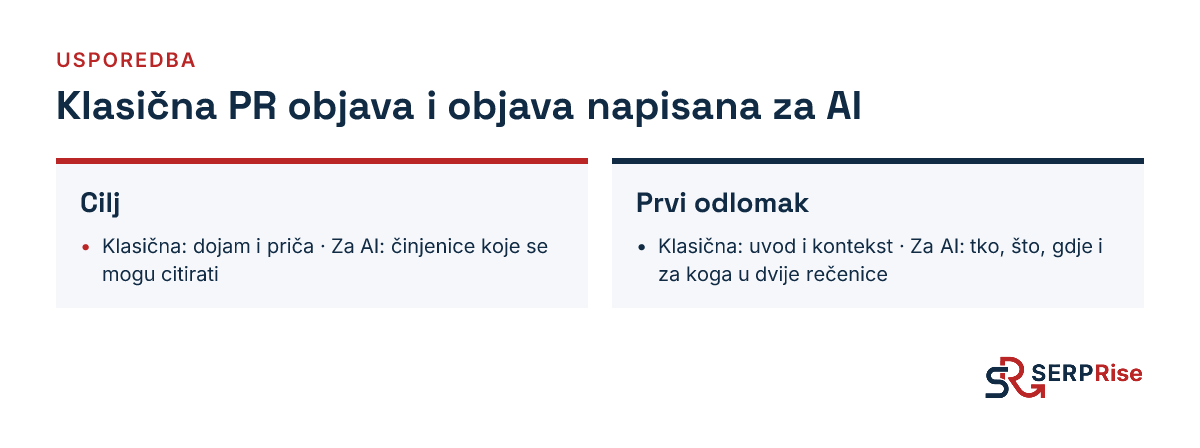
| Classic PR article | Article written for AI citation | |
|---|---|---|
| Goal | Impression and story | Facts that can be cited |
| First paragraph | Introduction and context | Who, what, where and for whom in two sentences |
| Brand name | Pronouns after the first mention | Full name in key paragraphs |
| Line of business and city | Often implied | Stated explicitly |
| Price | Rarely | A price or range in euros |
| Structure | Long paragraphs | Subheadings as questions, a list, short paragraphs |
| Quote from the director | General, about the vision | Specific, with name and job title |
| Link | To the homepage | To the service or product page |
This approach is backed by data too. Alex Groberman on X shares a study that analysed 11,882 queries and 304,805 URLs cited in ChatGPT, Google AI Mode and Perplexity. It compared them with 921,614 URLs that are in Google’s top 20 results but are not cited by AI. The cited pages had better clarity and conciseness (+32.83%), stronger expertise signals such as author information and expert sources (+30.64%), used the Q&A format more often (+25.45%) and had clearer structure with headings, lists and tables (+22.91%). The same applies to a PR article as to a page on your own site.
PR article template for AI citation
The template has seven blocks. The order is not strict, but every block should be there.
- A headline with the brand and line of business. The company name and what it does, ideally the city too.
- A first paragraph with a clear claim. Who you are, what you offer, where and for whom.
- A paragraph with the price. A price or range in euros for the main service or product.
- A subheading phrased as a customer question. E.g. “Koliko košta implantat u Splitu?” (How much does an implant cost in Split?)
- A short list of facts. Three to five items: years in business, services, location, opening hours.
- A quote from a named person with their job title. A specific statement, not a general message.
- A link to the relevant page. To the service page, not just the homepage.
Example first paragraph
Illustrative example: a fictional company and fictional amounts.
Dentalna ordinacija Primjer iz Splita nudi ugradnju zubnih implantata za pacijente iz Dalmacije i inozemstva. Cijena jednog implantata s krunicom u ordinaciji Primjer kreće se od 900 do 1.400 eura, a prvi pregled s planom terapije traje 45 minuta.
(In English: “Primjer Dental Practice in Split offers dental implants for patients from Dalmatia and abroad. The price of a single implant with a crown at the Primjer practice ranges from 900 to 1,400 euros, and the first examination with a treatment plan takes 45 minutes.”)
The paragraph is citable because it makes sense without the rest of the text. It contains the brand name, line of business, city, target group and price. Notice that the name “ordinacija Primjer” (the Primjer practice) is repeated instead of the pronoun “it”. When AI extracts only the second sentence, it still knows who it is about.
Watch consistency too. The brand name and the description of the business should be the same in all articles, on your website and in your Google Business Profile. If you are a “dental practice” in one article and a “dental centre” in another, AI has a harder time connecting them as the same company.
Which news site should you publish a PR article on so AI reads it?
Four criteria matter more than the size of the site:
- ChatGPT already cites the site for questions in your industry. Check this by asking the questions your customers ask and looking at the sources.
- It is indexed in Google and Bing. Without Bing you lose part of the path to ChatGPT.
- It does not block AI bots in its robots.txt file.
- It is topically close to your industry or region.
We have collected news sites with their DR, traffic and whether they use a “sponsored” label in our list of 335 Croatian news sites for PR articles, so we do not repeat them here.
DR is not the only criterion. When we asked ChatGPT 35 Croatian questions, the cited sources included pages with very low DR. We describe what those pages had in common in the article which pages ChatGPT cites in Croatia.
The “sponsored” label on a paid article is a legal obligation and there is no need to avoid it. We have not found publicly available, reliable data on how this label affects whether AI cites an article, so we draw no conclusions about it.
How to measure whether an article got into AI answers
Measurement starts before publication. Ask ChatGPT the same questions before and a few weeks after the article goes live, and compare the answers and sources. You will find a ready-made list of questions and a table in the article AI visibility check in 20 questions.
The second signal is visits. In GA4, set up a channel for AI assistants using our regex for AI visits in GA4, because the default channel does not catch every source.
At SERPRise we track, for every client, ChatGPT and Google AI Overview answers to Croatian queries and rankings via the DataForSEO API, all in the client’s live dashboard. We track links from news sites via the Ahrefs API, so you can see whether the article is indexed and whether the link is still in place.
Expectations need to be realistic. Whether an article gets into an answer depends on the question, the news site and the competition. Some articles never get in; some get in for one question but not another.
An 8-point checklist before sending your article to a news site
Each point is checked with a yes or a no.
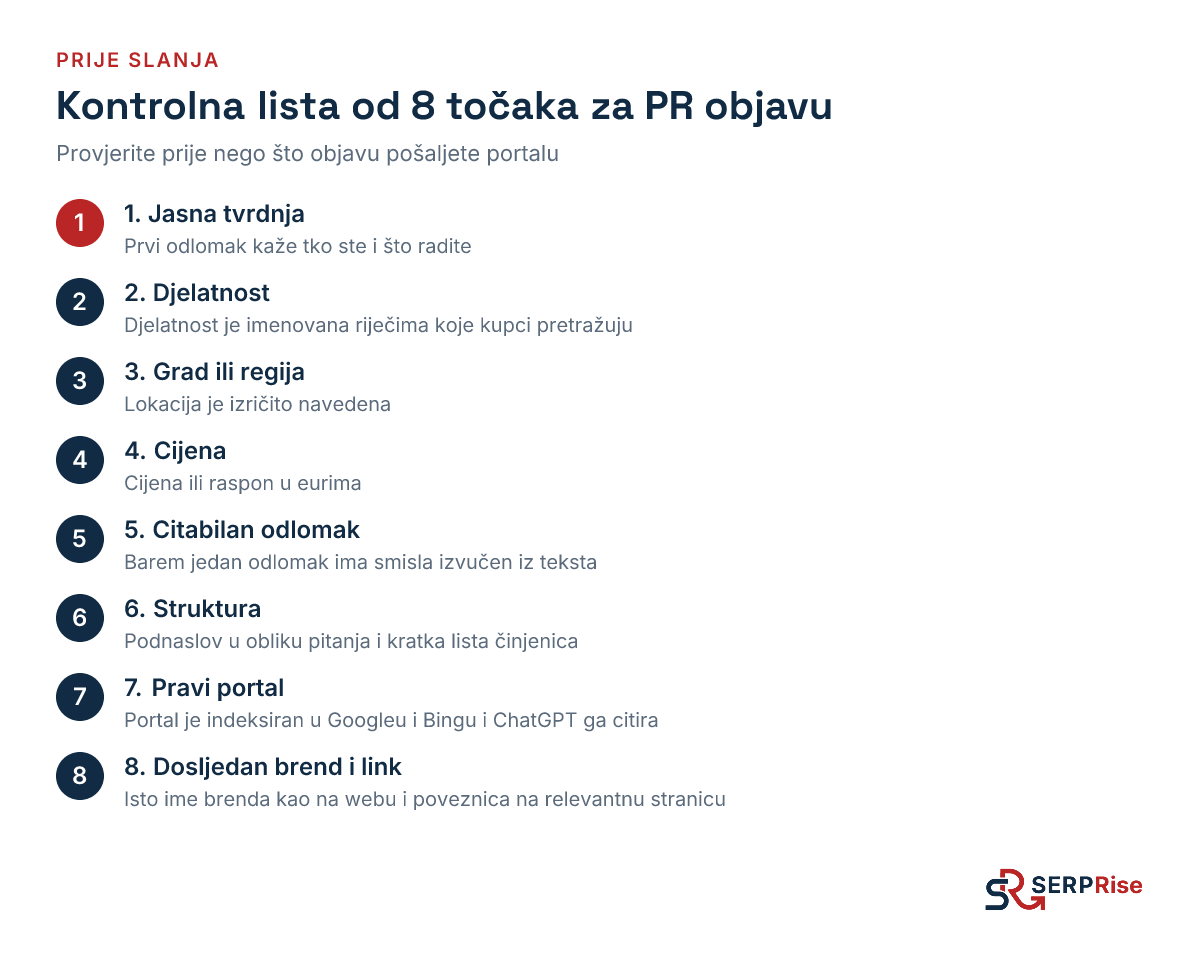
- Clear claim: the first paragraph says who you are and what you do.
- Line of business: it is named in the words customers search for.
- City or region: the location is stated explicitly.
- Price: a price or range in euros is given.
- Citable paragraph: at least one paragraph makes sense lifted out of the text.
- Structure: there is a subheading phrased as a question and a short list of facts.
- The right news site: the site is indexed in Google and Bing, and ChatGPT cites it.
- Consistent brand and link: the brand name is the same as on your website, and the link goes to a relevant page.
In short
How soon after a PR article can ChatGPT mention my brand? There is no fixed timeframe. The article must first be indexed, and then it has to match a question someone asks. Check the same questions at intervals of a few weeks.
Does a PR article labelled “sponsored” help AI visibility? The label is a legal obligation. We have not found reliable, publicly available data on its effect on AI citation. The content of the article and the choice of news site make a bigger difference.
Is it better to publish one article on a big news site or several on smaller ones? It depends on which sites ChatGPT cites for your questions. A smaller, topical site that already appears in answers can be worth more than a large general news site.
Can I send the same PR article to several news sites? The same facts, yes; the same text, preferably not. Adapt the headline, introduction and examples for each site, and keep the brand name, line of business and price consistent.
If you want to know which news sites ChatGPT cites in your industry and what your article should look like, see how our AI visibility service for Croatian companies works.