
AI Content for SEO: We Tested New Sites With 100% AI-Written Text
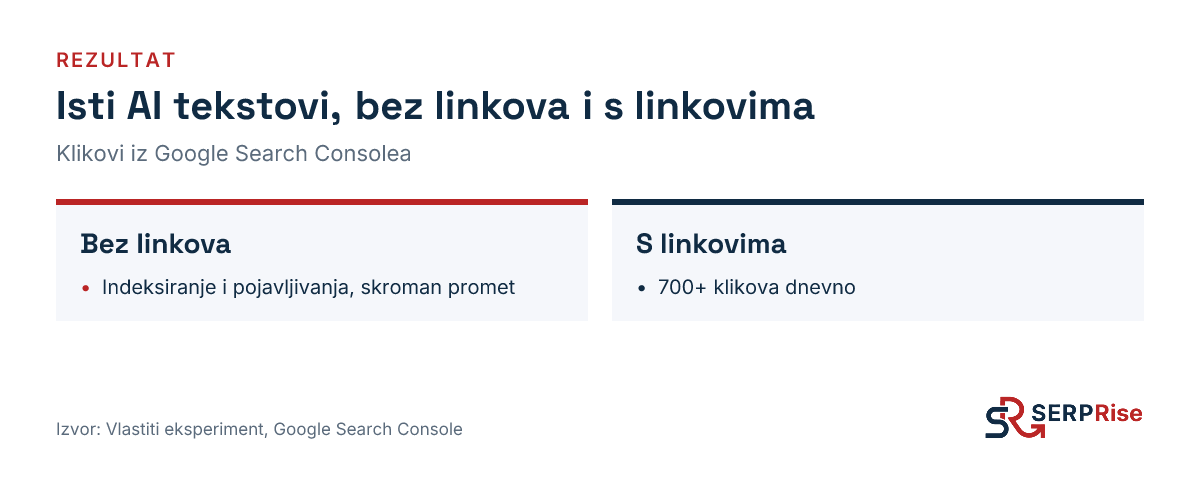
Yes, AI content can bring SEO traffic. I tested it on new sites where every piece of text was written entirely by AI, with no manual writing or rewriting. While the sites had no links, traffic stayed modest: the pages were indexed and got impressions, but very few clicks. Once I added links, the same texts reached 700+ clicks a day in Google Search Console.
Who wrote the text was not what decided it. What decided it was the site’s authority, meaning links and mentions from elsewhere.
Does AI content work for SEO? The short answer from our test
AI text on its own is neither the problem nor the solution. Google does not reject it because a machine wrote it, but it does not reward it just because it is well put together either. On a new site with no history, the text is only the entry ticket. Traffic comes when Google has a reason to trust the site.
I also wrote about the experiment on LinkedIn, in two posts: one about the first phase and one about the results after adding links. Here is the whole story in one place, with what the test shows and what it does not.
How the experiment with 100% AI text worked
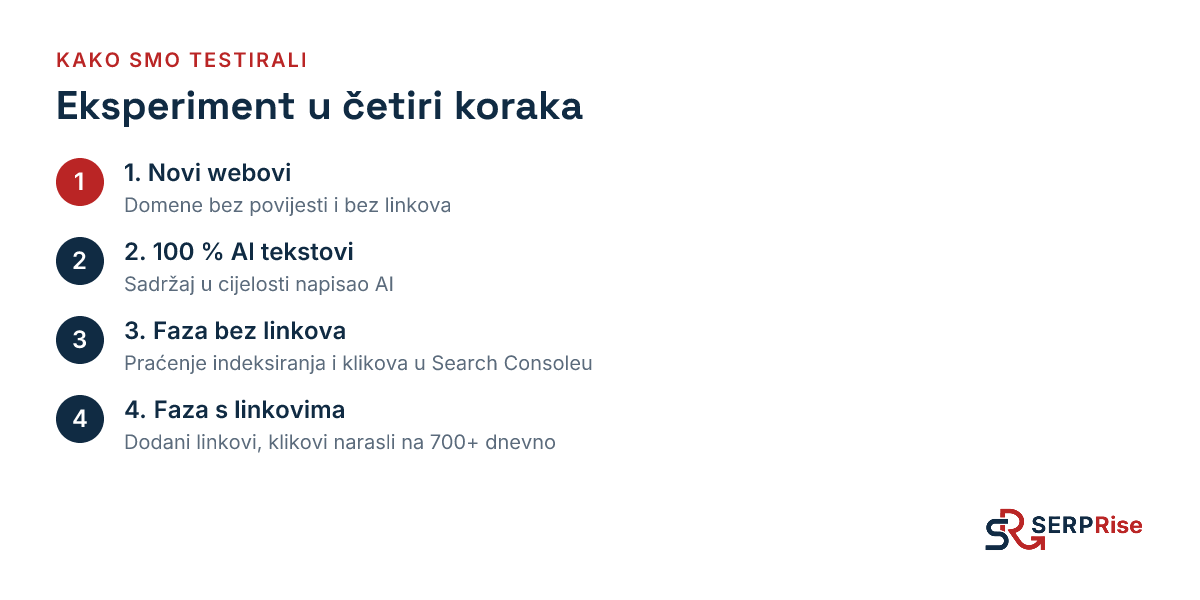
I set up the test to rule out as many other factors as possible:
- new sites: domains with no history, no links and no traffic;
- 100% AI-written text, published without manual editing;
- two phases: first with no links at all, then with links;
- measurement of clicks and impressions from Google Search Console.
The texts, the structure and the technical setup of the sites stayed the same through both phases. The only variable I changed was links.
If you want to track this kind of data yourself, see how to read your Search Console data.
What happened while the sites had no links
The pages were indexed and started appearing in search, but mostly in positions where hardly anyone sees them. There were few clicks and they did not grow, even though the texts did not change.
That is no surprise. A new site has none of the signals that would make Google put it ahead of pages that have had links, mentions and click history for years. A text can be clear and accurate, but for most queries Google has dozens of equally good texts. It chooses between them partly by who others trust.
We hear the same from small site owners: they work on keywords, edit their pages, submit URLs for indexing in Search Console, and traffic does not grow. Often the problem is not the text. The site simply has no authority.
When we added links: 700+ clicks a day
In the second phase the texts stayed the same. The only change was that the sites got links from other websites.
After that, clicks started to grow and reached 700+ a day.
What the experiment does not prove
It is only fair to state the limits of the test:
- One setup. The result holds for these sites, these niches and this period. It is no guarantee that every site with AI text and links will get the same traffic.
- It does not prove long-term stability. In her newsletter piece “It Works Until It Doesn’t”, Lily Ray analyses more than 220 domains that rapidly scaled AI content and shows a pattern of fast growth followed by a sharp drop. Our test does not answer what will happen in a year.
- It does not prove that text quality does not matter. It only shows that text without authority was not enough.
- It does not apply to just any links. Cheap links in bulk are a risk, not a shortcut.
Does Google penalise content written by AI?
Not because of who wrote it. In its guidance on AI content, Google says it assesses how helpful and high-quality content is, not how it was produced (Google Search Central).
The risk lies elsewhere. Google’s spam policies include scaled content abuse: publishing pages in bulk to rank rather than to serve the reader (Google’s spam policies). It makes no difference whether AI or people write them.
For Croatian there is also a practical risk. AI gets grammatical cases wrong, invents local facts and quotes outdated prices or prices in kuna (Croatia’s former currency). An algorithm does not spot these mistakes; the customer does, and immediately.
Does the same apply to ChatGPT and Google’s AI Overviews?
Mostly, yes. Google published “Good SEO is good GEO” by Brendon Kraham, which says that AI Mode and AI Overviews rely on the same ranking and quality systems as classic search and pull information from the existing index. That is how Alex Groberman on X reports it. In other words, the authority that brought clicks in our test also helps in AI Overviews.
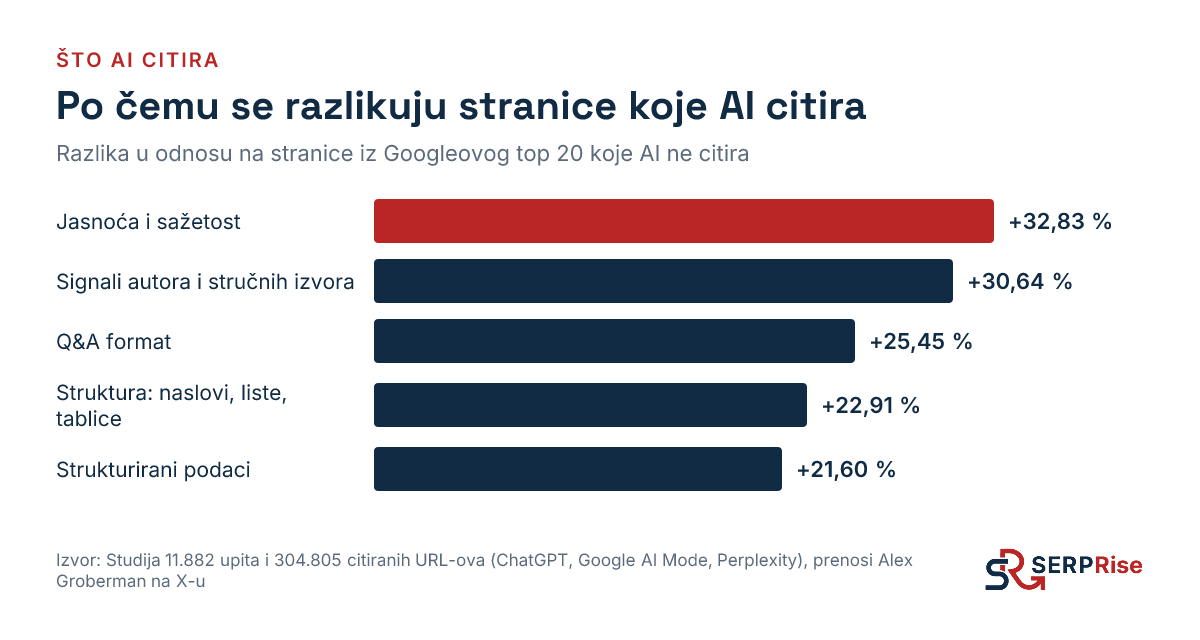
Groberman also shares a study that analysed 11,882 queries and 304,805 URLs cited by ChatGPT, Google AI Mode and Perplexity, and compared them with pages from Google’s top 20 that AI did not cite. The cited pages differed as follows:
| Trait | Difference |
|---|---|
| Clarity and conciseness | +32.83% |
| Author and expert source signals | +30.64% |
| Q&A format | +25.45% |
| Structure: headings, lists, tables | +22.91% |
| Structured data | +21.60% |
ChatGPT is not just Google. As Nathan Gotch writes on LinkedIn, ChatGPT can cite a page that is not in Google’s index at all, because OpenAI has its own index and uses Bing. That is why mentions on other websites count outside Google too.
For questions with a local or buying element (Croatia, a city, a price, an agency), ChatGPT cites Croatian pages. We describe the details in our piece on which pages ChatGPT cites in Croatia, and our guide to LLM visibility gives the wider picture.
How to use AI content so that it brings traffic
AI saves time on the first draft. The rest of the work is still yours.
| What AI does | What a human does |
|---|---|
| First draft | Checking facts and figures |
| Suggested structure and headings | Own examples and experience |
| Summaries and FAQs | Prices in euros and local context |
| Description variants | The final call on what gets published |
Rules for AI text in Croatian:
- Read the whole text and fix cases, gender and agreement.
- Check every price. Euros only, and current ones only.
- Check local facts: laws, cities, names of institutions, deadlines.
- Cut sentences that say nothing and phrases translated from English.
- Add at least one example AI cannot know: your process, your client, your figure.
A structure both people and AI can read: the answer in the first paragraph, H2 headings as questions, tables for comparisons, a short FAQ and a clearly named author.
Authority from outside: links and mentions on relevant websites. For the Croatian market that mainly means Croatian news sites and specialist sites. We put together an overview of Croatian news sites for PR articles and which of them ChatGPT actually cites. A few quality mentions are worth more than hundreds of links from unknown sites.
At SERPRise, every client has their own live dashboard where we track rankings and clicks (we pull the data through the DataForSEO and Ahrefs APIs) as well as ChatGPT and Google AI Overview answers to Croatian queries. That way we see what new content brought and what links and mentions brought, instead of guessing.
In short
AI content works for SEO, but on its own it does not bring traffic to a new site. In our test, the same 100% AI texts gave modest traffic without links and 700+ clicks a day with links. The same signals, authority and clear structure, apply to Google’s AI Overviews and to ChatGPT.
Does Google penalise texts written by ChatGPT? Not because of how they were produced. It penalises mass-produced content with no value, whoever wrote it.
Can a new site with AI text get traffic without links? It can get indexed and earn impressions, but in our test meaningful traffic only came after links.
Does ChatGPT cite pages with AI content? ChatGPT looks at clarity, structure and authority, not at who wrote the text. It can also cite pages outside Google’s index because it uses its own index and Bing.
How much AI text needs manual editing before publishing in Croatian? All of it needs reading. Cases, prices in euros and local facts are checked in every text, and your own examples are added by hand.
If you want to know what your site is missing for Google and ChatGPT to start recommending it, see how we handle AI visibility for your company and get in touch.